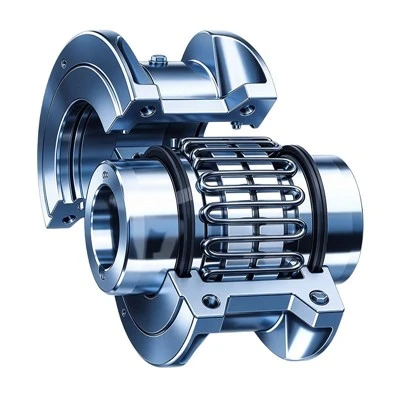
Rigid couplings are composed of rigid power-transmitting components that do not allow for relative movement between the connected parts; consequently, they lack the ability to compensate for relative misalignment between the two shafts. They are suitable only for applications where the shafts can be precisely aligned during installation and where no relative displacement occurs during operation. Flange couplings, which lack elastic elements, do not provide vibration damping or shock absorption; they are generally appropriate only for operating conditions characterized by steady loads and an absence of impact or vibration.
Rigid couplings-formerly referred to as fixed rigid couplings-include types such as flange couplings, radial-key flange couplings, muff couplings, clamp-shell (split-muff) couplings, and sleeve couplings. In general, rigid couplings feature simple construction and low manufacturing costs. When selecting a rigid coupling, alignment errors between the two shafts should be minimized; furthermore, to reduce the impact of additional loads on the coupling, the distance between the coupling and the bearings should be kept as short as possible. Flange couplings connect two flange-style coupling halves using bolts.
Rigid couplings come in two primary structural configurations: one relies on fitted bolts (in reamed holes) for shaft alignment and uses the bolt shanks to withstand compression and shear forces for torque transmission; the other achieves alignment through the mating of a protruding shoulder on one coupling half with a corresponding recess on the other. In the latter type, standard Grade A or B bolts are used to join the halves, and torque is transmitted via the frictional force generated at the mating surfaces. Rigid couplings are typically made of gray cast iron or carbon steel; however, cast steel or forged steel should be used for heavy-load applications or when the peripheral speed exceeds 30 meters per second.